
Communication training for technical teams
Your technical experts don’t need to “dumb down” what they know. They need more of their expertise to land.
Executive Speaking Success helps engineers, scientists, clinicians, researchers, technical leaders, and subject-matter experts make complex ideas clear, credible, memorable, and actionable—without sacrificing rigor or asking people to become someone they aren’t.
Trusted by leaders and teams at NASA, GE Aerospace, Johnson & Johnson Innovation—JLABS, Intuit, and other organizations where complex ideas carry real consequences.
The expertise is not the problem
Your technical experts may know the science, engineering, product, system, risk, or opportunity better than anyone else in the room.
That depth is an asset. It can also make it difficult to decide what another person needs first.
Every qualification feels important. Every dependency seems necessary. Every chart adds proof. And when the audience doesn’t share the speaker’s context, the central idea can disappear inside the supporting detail.
The answer isn’t to remove the intelligence. It is to reveal the structure inside the intelligence so boards, clients, investors, regulators, partners, executives, and colleagues can understand why it matters and what to do next.
Read: How to communicate complex ideas without “dumbing them down” →
When this work matters
This work is useful when your people need to:
The assignment is not merely to transfer information. It is to create the conditions in which trust, good decisions, and useful action become possible.
Who this is for
Programs can be designed for:
They don’t need beginner-level speaking instruction. They need communication development that respects the sophistication of their thinking and the reality of the rooms they are entering.
What changes
Identify the minimum complete understanding an audience needs now. Minimum without complete becomes simplistic. Complete without minimum becomes overwhelming.
Structure, slides, data, language, examples, and delivery begin working together so the audience can follow the idea.
Experts relax into the credibility they have earned and guide the audience instead of repeatedly proving they belong in the room.
Story, analogy, evidence, and concrete language help people grasp why the technical truth matters.
Leaders share enough of their thinking, values, experience, and hard-earned insight for people to understand why they can be trusted to lead.
Participants practice listening, difficult questions, interruptions, resistance, and the moments when information overload is most likely to take over.
How the program works
This is not a generic workshop dropped onto a technical audience. The strongest programs are built around the people, business context, and communication moments that actually matter.
Who needs to communicate, with whom, about what, and what needs to happen differently as a result?
Participants learn practical, science-grounded principles for clarity, trust, story, presence, audience-centered communication, and inspired action.
Participants use current presentations, product narratives, technical explanations, customer conversations, leadership stories, or organizational priorities.
People need a safe, demanding place to try, adjust, and discover what works authentically for them.
A focused intensive may solve one challenge. A longer journey can combine workshops, cohort sessions, coaching, recording, review, and repeated application.
Flexible by design
The right engagement may include:
Programs can be delivered in person, virtually, or through a thoughtful combination of both.
You are not buying a workshop. This is an investment in effective communication capacity.
Proof in practice
GE Aerospace was preparing senior technical leaders for a rare global customer summit. Over six months, John helped the executives replace information overload with a clear narrative spine, translate complexity without compromising it, and communicate without hiding behind teleprompters.
The executive sponsor later called it the best event of her career. A senior Emirates Airlines leader compared the experience to TED and said he didn’t want the talks to end.
“John was a transformation, not only for me, but for all the speakers at this customer engagement.”
Gary Mercer, then VP of Engineering, GE Aerospace
What began with one leader’s TEDx talk became a 15+ year relationship that has included leadership-team development, programs across the United States and Europe, and ongoing pitch coaching for scientific startup founders.
The work helps highly technical innovators explain what they are building, why it matters, and why other people should believe in the future they see.
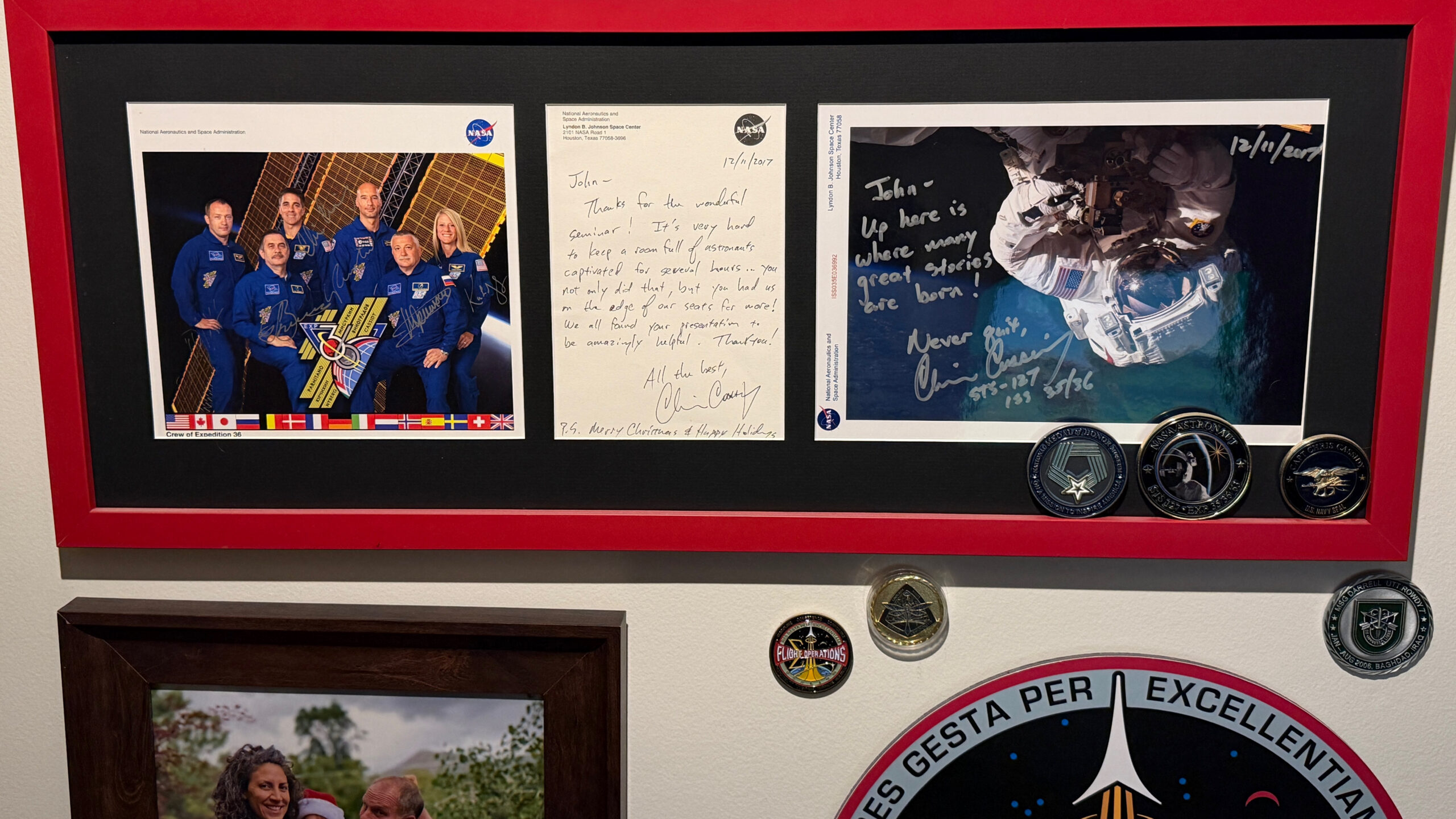
“Thanks for the wonderful seminar! It’s very hard to keep a room full of astronauts captivated for several hours… you not only did that, but you had us on the edge of our seats for more! We all found your presentation to be amazingly helpful. Thank you!”
Chris Cassidy
Retired NASA astronaut and U.S. Navy SEAL
Personal note to John after a communication seminar for NASA astronauts.
Private coaching or team development?
Private coaching is usually the right fit when one leader is preparing for a board, investor, customer, media, or other high-stakes moment—or when a new level of leadership requires deeper individual development.
A customized program is usually the right fit when several leaders need common principles, practical application, individual feedback, and a language the organization can continue using.
Many organizational relationships begin with one leader and expand after the value becomes visible.
Questions organizational buyers ask
No. John doesn’t replace the subject-matter expert. His role is to help experts identify the essential idea, understand the audience, build the path, use evidence and analogy responsibly, and make their own expertise easier to receive and act on.
No. It is about sequencing information and preserving the truth. Important specialist detail may belong in the main presentation, an appendix, a technical session, or the conversation that follows. Clarity is not the absence of complexity. It is evidence that the complexity has been processed.
The most useful work is built around real messages and situations. The appropriate way to handle sensitive material can be discussed during program design so the work remains both relevant and responsible.
No. Presentations are one application. The same principles strengthen board conversations, executive reviews, client discussions, pitches, panels, media interviews, cross-functional meetings, leadership stories, and difficult conversations.
Yes. The program can be designed around the organization, audience, roles, business context, communication moments, and outcomes that need to change. Customization means more than putting a logo on standard slides.
Yes. Programs can be delivered virtually, in person, or through a blended design. The right format depends on the group, timing, desired outcomes, and level of practice and coaching required.
A focused session can address one immediate need. A multi-session or multi-month engagement creates more opportunity for teaching, application, feedback, coaching, and reinforcement to become part of how the team works.
We discuss the people involved, the moments that matter, what needs to be different, and whether Executive Speaking Success is the right partner. If it is, we can recommend a sensible starting point and scope.
Make the expertise available
Your experts don’t need to become less technical, less precise, or less themselves.
They need their communication to become a match for how good they really are.
A thoughtful first conversation about your people, the communication moments that matter, and the outcome you need to create.